
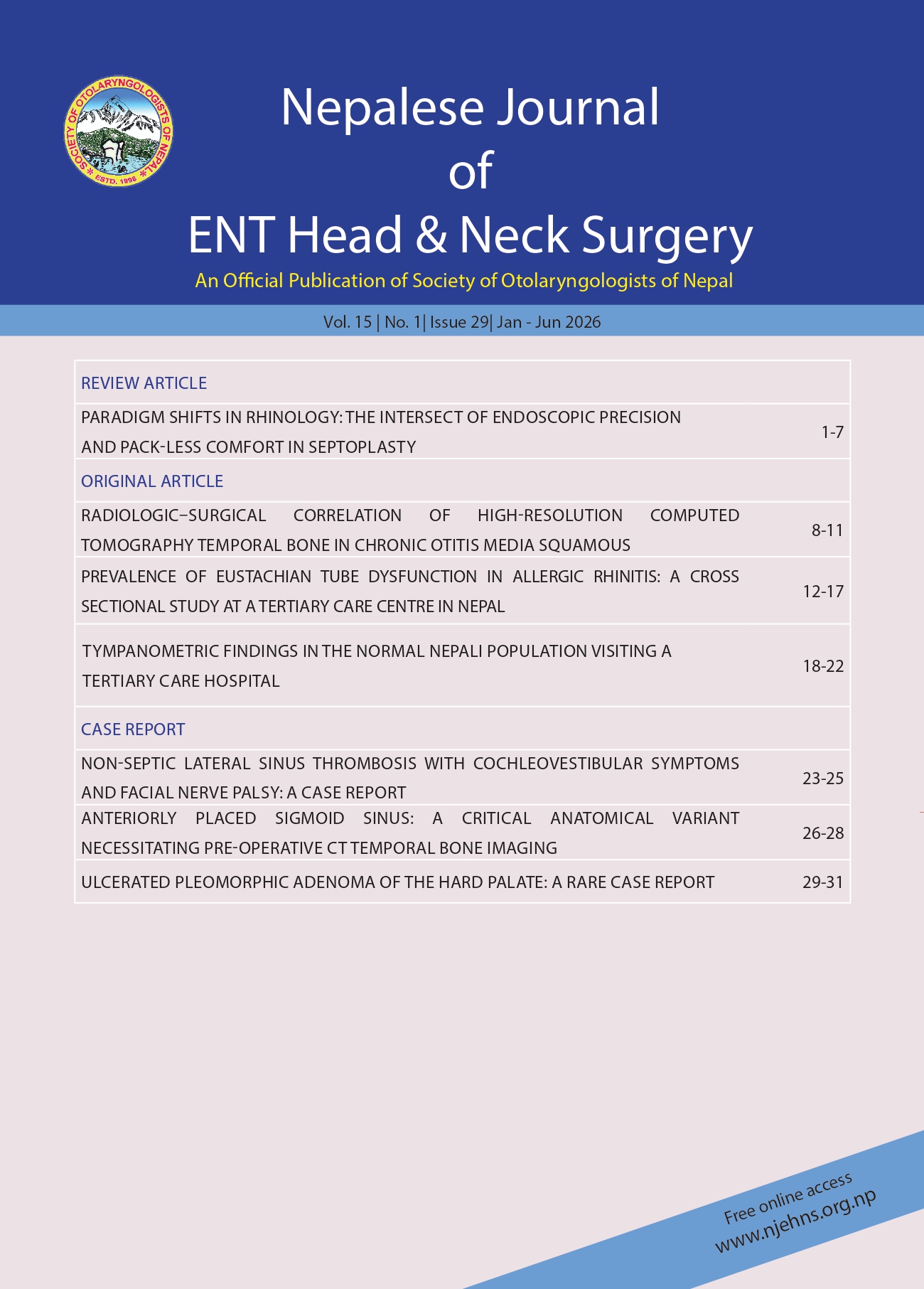
Prevalence of Eustachian Tube Dysfunction in Allergic Rhinitis: A Cross Sectional Study at a Tertiary Care Centre in Nepal
Abstract
Aims and Objectives: This study investigates the prevalence of Eustachian tube dysfunction in patients with AR by assessing tubal health and analyzing tympanometry findings. It specifically examines how nasal symptoms contribute to tubal impairment.
Methods: This descriptive cross-sectional observational study was conducted at Nepal Medical College Teaching Hospital over 12 months. Ninety patients diagnosed with allergic rhinitis were recruited using purposive sampling. Subjective assessment was performed using the 7-item Eustachian Tube Dysfunction Questionnaire, while objective evaluation included otoscopy and tympanometry.
Results: Out of 90 cases, there was highest frequency of patients aged 15-25 years with no gender predilection. Students and housewives were the most prevalent occupation (26.7% and 22.4% respectively). The prevalence of Eustachian tube dysfunction was 31.1%. Nasal obstruction and Eustachian tube dysfunction questionnaire score were statistically significant factors for Eustachian tube dysfunction (p value 0.04 and 0.001 respectively).
Conclusion: Nasal obstruction is an important factor for development of Eustachian tube dysfunction in patients with allergic rhinitis. Scoring system can possibly be used as a screening tool for assessment of tubal pathology in patients with allergic rhinitis.
Keywords: Allergic rhinitis; Eustachian tube; Eustachian tube dysfunction questionnaire score; Tympanometry.
Downloads
Published
How to Cite
Issue
Section
License
Copyright (c) 2026 Nepalese Journal of ENT Head & Neck Surgery

This work is licensed under a Creative Commons Attribution-NonCommercial 4.0 International License.